
Frequently asked questions about community cats
What is a community cat?
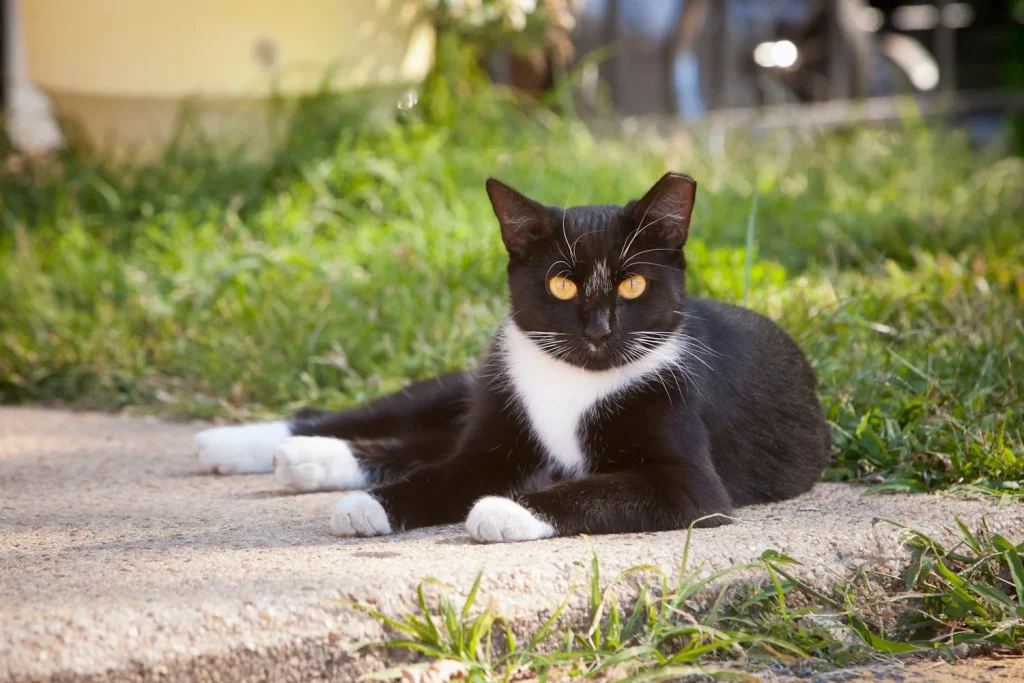
Community cat populations typically consist of a mixture of feral, semi-socialized, and lost or abandoned cats. The traditional idea of community cats was that they were feral and had little to no human interaction, with little chance of being socialized enough to live indoors as a domestic pet. As more research has been done in recent years, we have discovered that this is simply not the case. A community cat can be someone’s lost cat that has joined a nearby colony, someone’s indoor/outdoor cat that frequents the area, kittens raised by colony caretakers who have grown into friendly outdoor cats, and true feral cats. All these cats call the outdoors home and have different backgrounds compared to a traditional true feral cat.
Why TNR?
Proven to be one of the only ways to help reduce and keep the community cat population healthy, SNVR (Shelter-Neuter-Vaccinate and Return) and TNVR (Trap-Neuter-Vaccinate and Return) are fully supported by the Animal Rescue League of Berks County and all major national animal welfare organizations.
TNR is the only effective method to decrease the number of cats humanely and dramatically. Trapping and removing the cats doesn’t work because cats in nearby territories will move into the area and breed up to capacity. This is well-documented over decades of studies and is called the “vacuum effect.”
Despite how hard local animal welfare organizations have collectively tried in the past, old methods simply have not worked, as evidenced by the number of cats we see today in our county. We cannot euthanize or adopt our way out of the current cat crisis in Berks County and must collectively turn to methods proven to work for long-term solutions to reach a more manageable population.
What is SNVR?
Shelter Neuter Vaccinate Release (SNVR)
All cats that go through this program are examined by veterinary staff, spayed/neutered, left ear-tipped, and rabies vaccinated. While the general assumption is that all outdoor cats are feral, this is not the case and many of these cats regardless of behavior call the outdoors home.
What is a SNVR candidate?
The criteria for a SNVR candidate are very simple. If a stray cat comes in, has an exact location where found, is in good health and body condition, and has no microchip or identifying tags, it is a SNVR candidate.
Why is it necessary to return cats back to the outdoors, especially if they aren’t feral?
Our domesticated cat species has been living outdoors alongside humans for the last 10,000 years and is highly adaptive, living in almost all climates and regions of the world. In fact, cats didn’t become indoor pets until litter was invented and sold in the 1950s.
While we would love for all cats to have indoor homes and families to call their own, the outdoor cat population is far greater than the available number of adoptive homes. Berks County has an estimated 32,000-60,000 outdoor community cats! And even though ARL runs free adoption events regularly, the shelter is still overflowing with cats at all times of the year.
The role of animal shelters is to help the greatest number of animals in a community to make the biggest impact possible to improve animal welfare overall. We make data-based decisions to try and move the needle to get Berks County to a better place for all cats, which means spaying/neutering as many as possible every year.
Because of shelters’ unique role of helping the highest number of cats possible, even if all we can do for some is to ensure that they are protected with vaccinations and spayed/neutered before being returned to their outdoor homes, that’s a worthy step toward improving cats’ lives and preventing unwanted future litters from being born outdoors that add to the overpopulation crisis.
Our greatest hope is that one day all cats will have a human family to call their own, but until then, we do our best to support as many cats as possible to live better and healthier lives.
Are kittens being sent back outside as well?
Currently, we are excluding cats younger than three months from the SNVR program. As shelter populations ebb and flow, so will the age ranges that we put back outside for friendly cats.
When is weather a concern for release?
These community cats are used to the weather in their area, but due to recovering from spay/neuter surgery, we may hold them from release until the weather clears. When a Code Red or Code Blue is issued by the Department of Animal Protection, the release will not be performed until the Code is over. Other instances that may require delayed release are severe rain or thunderstorms and heavy snowstorms. It is important to remember that these cats are accustomed to this weather and have successfully lived outside before coming to us.
What does an eartip mean?
When a cat is spayed or neutered as a community cat, the left ear will be tipped while the cat is under anesthesia. This in no way harms the cat and signifies that it is a community cat and should be left where it is, unless you can tell it’s physically not doing well in its outdoor environment and is seriously ill or injured.
What is ARL doing to address the community cat crisis in Berks County?
ARL has worked hard to expand programming that can more effectively affect change on this problem.
- While we are only one organization, we are doing our part to model the solutions that we know have worked elsewhere throughout the country. We brought in specialist trainers from Best Friends to learn best practices for lifesaving outcomes for cats and are committed to advancing this goal.
- A commitment to move away from high euthanasia and into lifesaving outcomes so cats can thrive in all environments (shelter system, outdoors, in homes, etc)
- Efforts to expand our organization to be able to gain funding to start and maintain TNR programming in a consistent and high-volume capacity
- Instituting the SNVR/TNVR programs to intake and help as many cats as our capacity will allow and to push the number of annual spays/neuters higher
- Instituting low-cost TNR at $50
- Creating the donor and grant-funded CatSnip grant program that provides funds for ARL-led TNR efforts in the community.
- Expanding the number of veterinarians on staff to do spay/neuter surgeries for the public
- Developing a volunteer program and coalition with county trappers/TNR enthusiasts to work collaboratively and reduce barriers to surgical access
- Working with other animal-welfare organizations to support and advance TNR efforts however possible
What do I do if I find a community cat?
The ARL offers Berks County residents support and helps trap-neuter-vaccinate-return (TNVR) outdoor cats. Due to our limited resources, the ARL does not come and pick up outdoor cats. Still, we do offer guidance and support to help you humanely deal with the cats, to help you humanely keep the cats off of your property with the use of ultrasonic or other deterrents, and to help you decrease or eliminate their population over time.
Why does the ARL return friendly cats to the field? They may be lost or abandoned.
Not All Who Wander Are Lost. According to a study from Best Friends Animal Society, 31% of cat owners allow their cats to spend some time outdoors. If the cat is lost and no microchip or identification is found, the cat is placed back where he/she was found so they can find their way home once they identify smells and location. Learn more about Lost Cat Behavior here.
Cats that seem injured, ill or malnourished are not candidates to go back out. Those are signs that they are not doing well outside.
We also partner with community caretakers at all opportunities to try and ensure that cats placed back into the field are monitored and safely reintroduced to the colonies they came from.
Not all RTFs have official caretakers, but we do ask people to keep an eye on how they’re doing whenever possible.
Which are the steps in dealing with these cats?
If you’re reading this, you’ve already taken your first steps as someone who’s concerned for the welfare of these ownerless cats, as well as being someone who’s interested in seeing their population decrease. Your involvement in this process is critical. Please take a moment to read these important steps:
Step 1: Identify all people who are feeding the cats. Once you have, please coordinate the feeding of the cat or cat colony once or twice a day. Cats should be fed 5.5 oz of wet food (large can) and a quarter cup of dry food per cat per day (half-cup if only dry); please make sure to pull any uneaten wet food immediately after the cats have finished eating to ensure flies don’t lay eggs in the food. Please understand that overfeeding cats will likely cause more cats to join the colony. To successfully trap cats, cats must be hungry and know where and when to obtain food. Once a feeding schedule is established and set, please proceed to the next step.
Step 2: Call to make an appointment with us, No Nonsense Neutering or Fairchild Foundation. These organizations offer low-cost spay/neutering services for community cats; however, due to the feral cat crisis in Berks County, appointments may be booked out 3 weeks or longer during select times of the year. Clinics are offered as follows:
Animal Rescue League of Berks County offers appointments weekly. We also offer trap rental. Schedule an appointment by calling 610-373-8830 ext. 640.
No Nonsense Neutering offers four TNR clinics per month. They also offer trap rentals. Appointments can be made online. Up to four feral cats be neutered at once by appointment.
Fairchild Foundation offers TNR clinics on the third Sunday of each month. They also offer trap rental. Appointments can be made online for up to four feral cats.
To expedite your check-in, please make sure you visit the website of the organization you’d like to work with to read their complete guidelines, to complete their intake forms in advance, and to receive handy tips on how to trap and care for the cats prior to surgery effectively.
Step 3: Obtain a trap from No Nonsense Neutering, the Fairchild Foundation, or the ARL. Two types of traps are available to rent through the ARL: regular traps have a refundable deposit of $75, and drop traps have a refundable deposit of $150. Then it is $5 a day after 48 hours, which will come from the deposit.
What do I do if I find a litter of kittens?
If you should find a litter of kittens, please contact us as soon as you can so we can help figure out the best solution for them, depending on their age and condition. If the mother cat attending them and the kittens are safe, our policies reflect industry best practices to ensure the litter’s health, which is to stay with their mother as long as possible. You can offer the mother cat some additional support via a cat shelter in a different nearby low-traffic area filled with straw, clean water and food for the mother cat to increase their chances of staying put until the kittens are weaned and old enough for separation. If the mother cat sees you approach the kittens, it is common for her to move them around into different hiding spaces to keep them safe. Giving them privacy will increase the likelihood that you can keep an eye on them until you’re ready to take the next step.
Is there any cost to me to TNR outdoor cats?
While the ARL, unfortunately, cannot subsidize veterinary costs for all outdoor cats in Berks County, we are able to help people get a handle on a community cat colony in their neighborhood. We are very fortunate to have many community partners working together to help the community handle the outdoor cat crisis. You can still contact us, No Nonsense Neutering, or the Fairchild Foundation; all offer low-cost sterilization clinics for outdoor community cats. You may also contact your municipal leaders and ask if they offer financial assistance to help you with an outdoor colony of cats.
The ARL also participates of the SpayUSA program. Spay USA offers subsidy funding for stray and feral cat caretakers in New York, New Jersey, Connecticut and Pennsylvania. The application is open to individuals only; this is not a grant for animal shelters or other rescue organizations. Select the Animal Rescue League of Berks County when applying if you plan to use our clinic. Find more information about this subsidy and apply here.
Please know that while you are under no obligation to do anything to help these cats, ignoring the problem will only lead to the cats continuing to reproduce, which will only lead to more cats. Very rarely will the cats move onto another location when they are receiving food, water, and shelter in an area that they consider to be “home.”